What’s limiting your success?

September 16th, 2011

When reality television’s “Drag U” headmaster RuPaul meets individually with the everyday women who’ve enrolled to unleash the power of their inner diva, he asks a critical question: Who do you think is your saboteur? The answer each typically gives is “Myself.”

I think the question is valid for anyone who lacks confidence or feels powerless to change her or his professional situation. It’s a query to ponder whenever we feel stuck or hold the belief that we’re limited in our ability to get ahead.

In “The Fifth Discipline,” Peter M. Senge discusses the “power of powerlessness” and includes some interesting assertions by organizational consultant Robert Fritz, author of “The Path of Least Resistance: Learning to Become the Creative Force in Your Own Life.” According to Fritz, who has worked with tens of thousands of people, most of us hold one of two underlying beliefs that limit our ability to create what we want for ourselves. The more common belief is in powerlessness – that we lack ability, and the other belief is that of unworthiness – that we don’t deserve to have what we desire.

We can all expand on our desire and innate ability to create the results we want for ourselves. And it begins with an awareness and examination of beliefs.

The next time you’re feeling fear, anxiety or self-doubt about your professional abilities, ask yourself a few simple questions. What do you believe about yourself? What thoughts and suggestions do you give yourself during the day? How might you see things differently? What beliefs, what thinking can you shift that will begin to address or improve your situation?

You are the leader of you. Allow yourself recognition of your worthiness and power to create your professional reality. Be sure of yourself. In other words, give your saboteur the boot.


Happier people work harder.

September 9th, 2011

The answer to the question posed in Sunday’s New York Times’ opinion-piece headline “Do Happier People Work Harder?” is a resounding Yes.

In national studies cited by co-authors Teresa Amabile, a professor at Harvard Business School, and independent researcher Steven Kramer, there is overwhelming evidence that employees’ engagement – their energy, focus and commitment to their work life – has an effect on performance that can make or break a company’s survival. In fact it’s estimated that America’s “disengagement crisis” costs $300 billion annually in lost productivity.

In their own study, Amabile and Kramer found that the single most important factor that engaged people in their work was simply “making progress in meaningful work.” And yet a remarkably high 95% of managers failed to recognize that contributing to meaningful work was the primary motivator for employees, way ahead of financial incentives.

So how do you foster energy and commitment throughout your company? How do you create meaningful work? How do you lead in a way that gets people to care?

Interestingly, also in the NYT Sunday Review section, Adam Bryant’s “Corner Office” interview with Enrique Salem, CEO of Symantec, holds a key-concept answer to those questions. In talking about what he’s learned over the years about leadership, Salem shares wisdom from his first manager: “You lead by how you influence other people’s thinking.” He tells Bryant, “It has to be about what you are trying to accomplish.”

What both articles emphasize indirectly is the importance of a company’s shared vision. A vision created and built on day-by-day that connects with your employees’ personal vision to do meaningful work. And while commitment and energy are keys to a company’s success, they can’t be forced on anyone. Commitment comes through free will. It’s a personal choice. A choice driven by a desire to better the world, to be personally fulfilled and happy.


Your inner fortress of solitude.

September 2nd, 2011

When Superman needed to take a step back from his work, he had his famed Fortress of Solitude. It was his Arctic stronghold, the isolated place he would go to think without distractions and tap his inner knowledge.

Even without a secluded fortress, we all have a need for solitude. Time to get away from coworkers, clients, phone calls and email. Time alone to access your own source of knowing about your life’s work, your business and your purpose. Small business marketing expert John Jantsch calls it “solo planning practice.” In his July 25th blog post, “The Business Case for Solitude,” he outlines the benefits of making it a habit to find time to be alone with your thoughts. Here are highlights from Jantsch’s insightful piece that can be applied to any size business:

“Hear yourself – A business can create so much noise that it becomes hard to listen to your own guiding voice. When we react, without witnessing our thoughts and actions through our true voice, we set ourselves up to be influenced in ways that our not genuine. Have you ever found yourself doing or saying something and soon after thinking, that’s not me, that’s not how I want my business to run?

“The voice in your head, the one that tells you why you’re doing what you’re doing, who you are and how you want others to experience you, is your true voice and solitude is the way you let that voice come back and remind you why you do what you do. This voice refuses to shout over the noise and deserves your full attention.

“Get clarity – Once you return to hearing yourself you can begin to organize what that means. Have you ever had one of those times when things don’t make sense and you don’t feel like you can find an answer? Or worse, things just don’t seem like fun anymore. Then, seemingly out of nowhere, a simple, elegant, perfect answer presents itself. That’s one of the things that being alone with your thoughts has to offer. You get the chance to relax and not try to find or force answers – which of course is what makes them appear.

“Clarity is what you need to in order to make the big decisions about your business, about your people, and about markets. Without it, you’ll be driven by the rush of the day and idea of the week.

“Learn to speak – Sometimes I talk too much. Most of us do. We get very nervous when there is silence and we stretch to fill up the silence whether it needs us to or not. This is as true for the stammering we might do in front of a prospect as it is for the conversations we have with ourselves. One of the odd benefits contained in the practice of solitude is that it better prepares us to not say things. To have the confidence that just enough has been said about something or someone. To know when to ask for help, when to say no and when to stand firm.

“Create higher – Innovation and creativity in most small businesses must develop in layers. It’s very difficult to come up with an idea for a product, service or product that won’t impact the overall brand, strategy, culture and customer.

“Quite often we get what seems like a great idea and we lurch into full implementation mode first. By stepping into solitude and summoning your thoughts about your business there you are more likely to start at the very overarching level necessary to consider the strategic impact first and then you can more accurately develop the projects, actions, patterns and processes needed to bring your innovation to life properly.

“Renew purpose – I believe that one of the greatest reasons to create a business is to create purpose – purpose in your life, in the lives of those that work in the business and at some level the lives of those that experience the business as customers, suppliers and mentors.

“When you connect your business to the higher purpose it serves for you, you are more apt to create patterns and actions that support that purpose and attract others that share or connect with that purpose.

“Practicing solitude forces you to consider, evaluate and connect with that purpose even as the constant natural forces of business try to erode it. Solitude is a great way for you to unearth that one driving purpose your business meets and help you evolve what that purpose can and does mean to all that come into contact with your business.

“This is the real stuff; this is what turns simple passion into focused commitment. Don’t wait until you go on vacation to consider this idea – make it part of the game, build it into the culture of your business and teach your customers about silence and solitude as an aspect of regenerating value for them.

“What does your intentional solo planning practice look like? Is it an hour a week, an entire day once a quarter? Can you pair it with another passion such as painting or nature? Can you build on small steps and extend solitude to the point where it captures a significant amount of your attention?”

Even if you won’t be resting this Labor Day weekend, I hope you’ll find a few moments of solitude to think about your life’s work and begin creating more for yourself and your business in the process.


Success begins with a state of mind.

August 26th, 2011

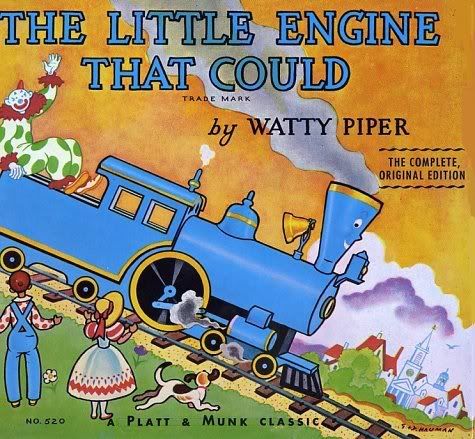
While browsing a table of books at the Brooklyn Flea on Saturday, I spotted the instantly recognizable cover illustration on Watty Piper’s “The Little Engine That Could.”

As I paged through this 1930s children’s classic about the helpful Little Blue Engine who saves the day while teaching the “I think I can” value of optimism and persistence, I was reminded of a verse from the same era that Napoleon Hill reprinted (without attribution or title) in “Think and Grow Rich” (1937) to emphasize the importance of self-confidence in the attainment of success. Check it out:

“If you think you are beaten, you are,
If you think you dare not, you don’t
If you like to win, but you think you can’t,
It is almost certain you won’t.

“If you think you’ll lose, you’re lost
For out of the world we find,
Success begins with a fellow’s will –
It’s all in the state of mind.

“If you think you are outclassed, you are,
You’ve got to think high to rise,
You’ve got to be sure of yourself before
You can ever win a prize.

“Life’s battles don’t always go
To the stronger or faster man,
But soon or late the man who wins
Is the man who thinks he can!”

These few  lines present a pretty big idea: Your mindset – your beliefs, thoughts and emotions – powers the engine that fuels your outcome. You achieve whatever it is you’ve been thinking about. That means if you’re thinking about something unwanted – like stressing over a slow quarter or worrying about a key-client or customer issue  – you’ll get that, too. In other words, you create your individual reality.

While this idea is not new, recent discoveries in cognitive and behavioral neuroscience support the concept, and their application in the business world has been picking up steam. Your mindset of unique beliefs about your professional reality drives your behavior and ultimately determines your results.

Whatever your present goal is, love the idea. Expect it. Believe it. Imagine how you’ll feel when you achieve it. I think you can.

Related Brain Food Blog posts:
☛  Wiring ourselves for success.
☛  Making sense of perception.
☛  The Ladder of Inference.


Some mind-boggling ideas about reality.

August 19th, 2011

Since attending the Secret Science Club’s encore screening of the 2007 BBC documentary “Parallel Worlds, Parallel Lives” last week, I’ve been reading everything I can find about Hugh Everett III, one of the world’s pre-eminent quantum physicists and the man who came up with the ground-breaking “Theory of Parallel Universes” almost 60 years ago at the age of 24.

Singer-songwriter Mark Everett, front man for the rock band Eels, grew up not knowing that his father was a genius, or that his dad’s many-worlds theory put him right up there with Einstein and Newton. Hugh Everett died when his son was 19, and, according to Mark, he  barely knew his father. So this film chronicles Mark’s journey to understand his father’s profound contributions to science.

Mark visits with Max Tegmark, professor of physics at MIT, who has spent years working on Hugh Everett’s theories and David Deutsch, a physicist at the University of Oxford, whose “Theory of Everything” builds on Everett’s many worlds interpretation of quantum physics. (Interestingly, Scientific American magazine’s cover story this month – “Questions about the Multiverse” – refers to the work of both Tegmark and Deutsch, with no mention of Everett as the inventor of the idea.)

Mark also gets a demonstration of the Double-Slit Experiment that shows how subatomic particles, until they are observed, will act as a wave, taking every possible path at the same time. In other words, only when observed, does a particle collapse down to one point as a single particle – and the reality of viewing that one particle is created by the act of observing it.

Before Hugh Everett’s time, physicists had been taught for generations that the equations of quantum mechanics worked only in one part of reality, the microscopic, and were not relevant at the macroscopic level. While this has been disproved in the last decade (see my post dated 6/3/11), it was Everett who first addressed the measurement problem by merging the micro and macro worlds – thinking of large objects as existing in quantum “superpositions,” that is, in two places at the same time.

It was Everett’s radical idea to ask, What if the continuous evolution of a wave is not interrupted by acts of measurement? What if no elements of superpositions are ever banished from reality? What if every time we make a decision, we “break off” into probable selves, with the observable probable self taking one possible path, and other probable selves taking other paths?

There’s mounting interest in Everett’s theories these days, and a biography by Peter Byrne I want to read. In the meantime, I’ll be mulling over this footnote from Everett’s thesis: “From the viewpoint of the theory, all elements of a superposition (all ‘branches’) are ‘actual,’ none any more ‘real’ than the rest.”

I’ll continue to think also about how the implications of Everett’s mathematically consistent worlds apply to thought, decision making, and our ability to create our own reality.

I think you’ll be fascinated by what you’ll find when you click through to “Parallel Live, Parallel Worlds” and the Double-Slit Experiment. And if not you, then one of your probable selves.